
Java4Shell Vulnerability (CVE-2026-114938): Check and Patch Java Now
CERT-In has flagged Java4Shell (CVE-2026-114938), a Base64 remote code execution flaw in Java 17, 21, 25 and 27. Here is who is at risk, how to check and how to patch.

Image: TeQBlogs
The Java4Shell vulnerability (CVE-2026-114938) is a remote code execution flaw in the Base64 decoder of modern Java runtimes. It affects Java 17, 21, 25 and 27 builds on recent Intel and AMD server CPUs, and India’s CERT-In rated it High in advisory CIAD-2026-0061 on 18 November 2026. The fix is simple: move to the patched Java builds released on 17 November, or apply a one-line JVM flag until you can.
If you run Java-based servers such as identity, CI/CD, wiki or search platforms, treat this as an urgent patch. Desktop users who only run Java apps locally are at much lower risk, but should still update.
Quick summary
- What: Memory corruption in the optimised x86-64 Base64 decoder used by
java.util.Base64.Decoder. - Who found it: Security firm Calif, which named it “Java4Shell”.
- Severity: Oracle scores it 8.1 (CVSS 3.1, high attack complexity, no login needed); Red Hat rates it Critical; CERT-In rates it High.
- Affected: Java 17.0.6 and later, plus 21, 25 and 27, on x86-64 CPUs with AVX-512 VBMI. Java 8, Java 11 and ARM64 systems are not affected (one Oracle Java 8 performance build is the exception).
- Fix: Oracle 17.0.21.1, 21.0.13.1, 25.0.5.1 and 27.0.1.1, or the matching builds from your Java vendor.
- Stop-gap: Start the JVM with
-XX:-UseBASE64Intrinsics.
What is the Java4Shell vulnerability?
Java4Shell is a bug in a speed-optimised part of the HotSpot virtual machine. On newer x86-64 processors, Java uses special AVX-512 instructions to decode Base64 text much faster. Red Hat’s bulletin explains that this fast path can corrupt memory when it handles specially crafted Base64 input, and CERT-In says a remote attacker could use malformed Base64 data in a request to run arbitrary code on the target system.
Also read: Upgrade Your WordPress Site Security
The danger comes from how common Base64 is. Web applications decode it all the time, often before anyone logs in: HTTP Basic authentication headers, SAML artifacts used for single sign-on, CSRF tokens and MIME-encoded email headers are all Base64. Red Hat specifically warns that Keycloak decodes Base64 before login, so authentication does not protect it.
Which Java versions and systems are affected?
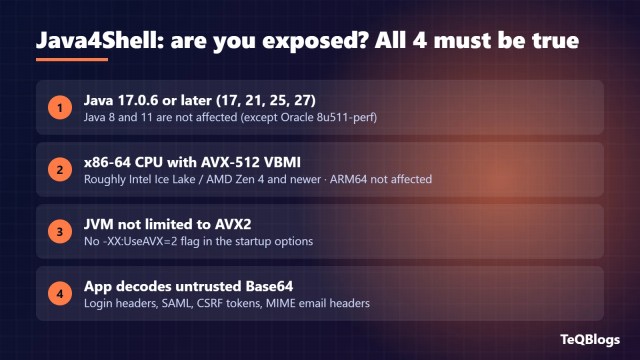
Java4Shell needs four things to line up. If any one of them is missing, your system is not exposed to this bug.
| Condition | Exposed | Not exposed |
|---|---|---|
| Java version | 17.0.6 or later, 21, 25, 27 (and end-of-life 18–20, 22–24, 26) | Java 8 and Java 11 (except Oracle Java SE 8u511-perf) |
| CPU | x86-64 with AVX-512 VBMI (roughly Intel Ice Lake / AMD Zen 4 and newer) | ARM64, and older x86-64 CPUs without VBMI |
| JVM settings | Default settings | JVM limited to AVX2 or lower (-XX:UseAVX=2) |
| Application | Decodes attacker-controlled Base64 | Never handles untrusted Base64 |
Oracle’s November 2026 Critical Security Patch Update lists these affected Oracle builds: Java SE 8u511b33-perf, 17.0.21.0.3, 21.0.13.0.3, 25.0.5.0.3 and 27.0.1.0.3; GraalVM for JDK 17.0.21.0.3 and 21.0.13.0.3; and GraalVM Enterprise Edition 21.3.20.0.3. OpenJDK builds from other vendors (Eclipse Temurin, Red Hat, Amazon Corretto and others) are affected until each vendor ships its fix.
Cloud servers deserve a close look. Red Hat names many current instance families as likely affected, including AWS C6i/M6i/R6i and C7i/M7i/R7a, Google Cloud C3, C4, N4 and M3/M4, and Azure Dsv5 to Dasv7 D-series machines.
How to check if your server is at risk
You can check a Linux server in under a minute. Run these commands as any user:
- Check the CPU:
grep -o avx512vbmi /proc/cpuinfo | head -1. If it printsavx512vbmi, the CPU has the vulnerable instruction set. No output means the CPU is not known to be affected. - Check Java:
java -version. A version of 17.0.6 or later, or any 21, 25 or 27 build older than the November 2026 fix, is potentially vulnerable. - Check containers and bundled runtimes. Many products ship their own JVM, so run the same check inside each container with
docker exec,podman execorkubectl exec. - List internet-facing Java services first: login and SSO servers, CI servers, ticketing and wiki tools, artifact repositories and search clusters.
How to fix Java4Shell: update Java
Updating the Java runtime is the real fix. Install your vendor’s patched build, restart every Java service, and then confirm the new version is running.

| Vendor | Fixed builds | Status |
|---|---|---|
| Oracle Java SE | 17.0.21.1, 21.0.13.1, 25.0.5.1, 27.0.1.1 | Released 17 November 2026 |
| Eclipse Temurin (Adoptium) | 17.0.21.1+2, 21.0.13.1+2, 25.0.5.1+2, 27.0.1.1+4 | Binaries published as testing completes; Docker images follow |
| Red Hat build of OpenJDK (RHEL 8, 9, 10) | Errata being expedited | Watch bulletin RHSB-2026-018 |
| Other vendors (Corretto, Zulu, Liberica, Microsoft) | Different build numbers | Check each vendor’s own advisory |
- Download the patched JDK or JRE from your vendor, or update through your package manager (for example
dnf updateorapt upgradeonce your distribution publishes the fix). - Update container base images and rebuild your own images on top of them.
- For products that bundle Java (Jira, Confluence, Jenkins, Keycloak and similar), use the vendor’s supported update rather than swapping the JVM yourself.
- Restart each service so it loads the new runtime, then run
java -versionagain.
Can’t patch today? Use the temporary JVM flag
Red Hat and Eclipse Temurin both recommend a temporary flag that switches off only the vulnerable Base64 fast path. Add it to your startup script or JAVA_OPTS, restart the service, and remove it after you upgrade:
-XX:-UseBASE64IntrinsicsThe flag may slow down applications that decode a lot of Base64, but it keeps other optimisations on. The alternative, -XX:UseAVX=2, turns off AVX-512 completely; use it only on x86-64, because an ARM64 JVM will refuse to start with it. An environment variable alone is not proof the flag is active. Red Hat suggests confirming on each running instance with jcmd <pid> VM.flags -all | grep -F UseBASE64Intrinsics, which should show false.
Is Java4Shell being exploited?
At the time of writing, we found no official confirmation of attacks in the wild, and Red Hat describes its investigation as ongoing. The researchers have reportedly shown code execution against default setups of several popular Java products, while holding back product-specific exploit code to give admins time to upgrade. With CERT-In now flagging it for Indian organisations, expect scanning to start soon. Our recent report on AI agents turning patches into exploits shows how quickly that gap can close.
For Indian businesses without a dedicated security team, this is a good moment to keep an inventory of every server and the software it runs. If you need help, Suprams offers cybersecurity services for businesses that include patch management.
Frequently asked questions
Do I need to update Java on my Windows PC?
Home users who only run Java desktop apps face little risk because attacks need a network service that decodes untrusted Base64. Updating to the latest Java build is still the safe choice.
Are Java 8 and Java 11 affected by Java4Shell?
No. Java 8 and 11 are not affected, except Oracle’s Java SE 8u511 Enterprise Performance Pack build, which Oracle lists as affected.
What is the CERT-In advisory number for Java4Shell?
CERT-In published it as CIAD-2026-0061 on 18 November 2026, titled “Remote Code Execution Vulnerability in Oracle Java SE and Oracle GraalVM Products”, with severity High.
Does the -XX:-UseBASE64Intrinsics flag fully fix the bug?
It blocks the vulnerable code path, but it is a stop-gap. Install the patched Java build as soon as your vendor releases it and then remove the flag.
Bottom line
Java4Shell is serious because Base64 is everywhere and the flaw can be reached before login. Check whether your servers run Java 17 or later on a recent x86-64 CPU, update to the November 2026 builds, and use -XX:-UseBASE64Intrinsics wherever you cannot patch today. For other urgent server fixes this month, see our guides on the PostgreSQL security update and updating PHP to fix PHP2Shell.
Sources
- CERT-In Advisory CIAD-2026-0061
- Oracle Critical Security Patch Update Advisory – November 2026
- Red Hat Security Bulletin RHSB-2026-018 (java4shell)
- Eclipse Temurin – November 2026 CSPU and java4shell
About The Author


